
A faster Shopify store is not achieved by minifying code alone. CSS, JavaScript and Liquid all affect how a theme is delivered and rendered. This guide explains what Shopify optimizes automatically, what you should review manually, and how to improve performance without breaking your storefront.
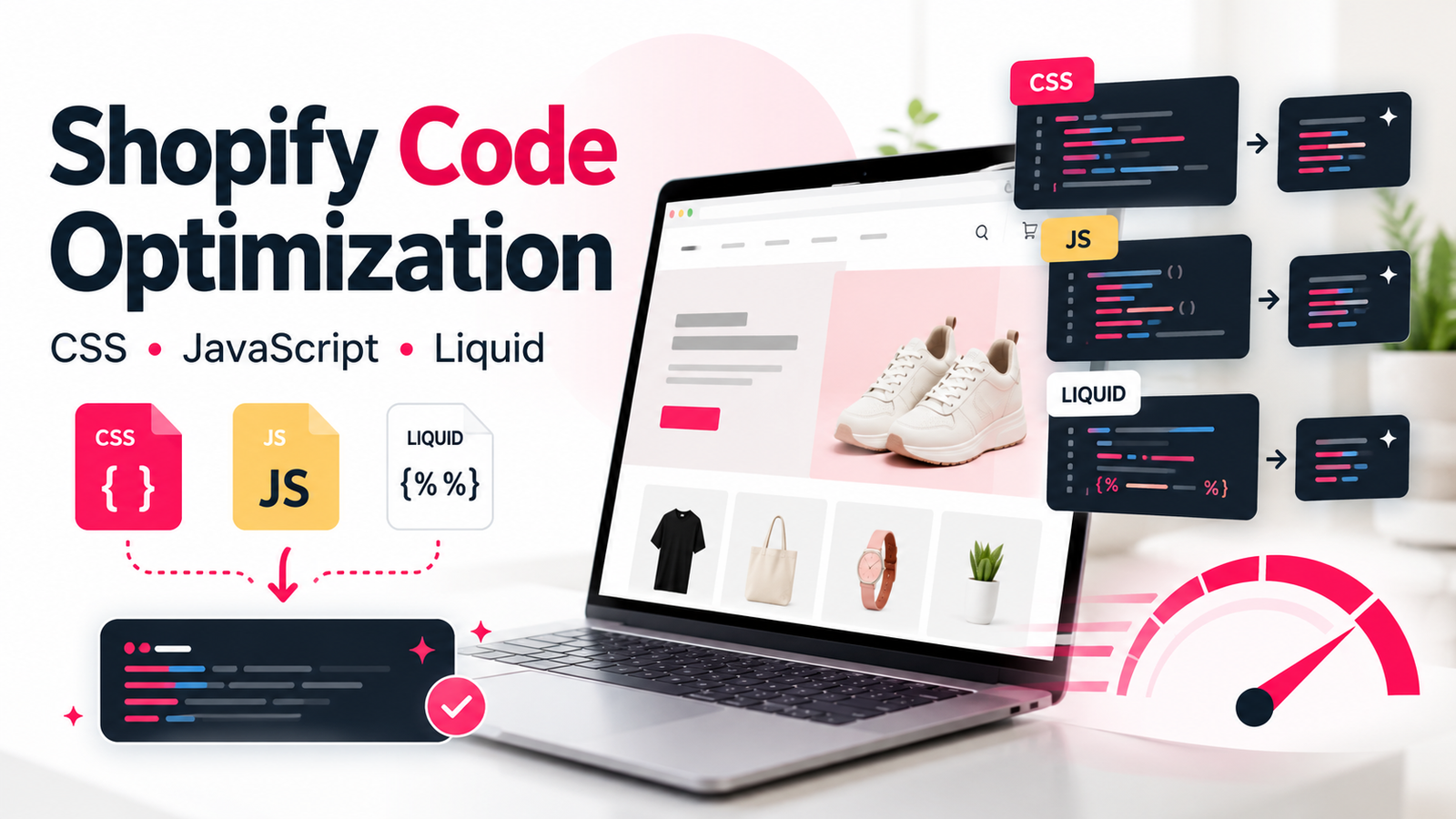
What is code minification?
Minification removes unnecessary characters—such as comments, extra whitespace and line breaks—from code without intentionally changing its behaviour. It can reduce transfer size, but it does not remove unused functionality or make inefficient code efficient.
Minification is different from compression. Compression (such as Brotli or gzip) reduces the amount of data transferred over the network; minification changes the code representation itself. A platform or CDN may apply both.
Does Shopify automatically minify CSS and JavaScript?
Shopify’s hosting and CDN infrastructure optimizes delivery of eligible theme assets, including minification of supported CSS and JavaScript assets. The exact result depends on how an asset is included and delivered. Do not assume that every inline script, third-party app file, externally hosted resource or custom response is automatically optimized.
Therefore, installing an app solely to minify every theme file is not automatically necessary. First measure the store, inspect the delivered resources and identify the actual bottleneck.
How to optimize CSS in your Shopify theme
- Remove styles that are genuinely unused, after checking all templates, sections, app blocks and responsive states.
- Avoid loading large stylesheets on pages that do not need them.
- Reduce duplicated rules and overly broad selectors.
- Keep critical above-the-fold styling efficient; avoid adding large amounts of inline CSS.
- Use the theme’s existing asset pipeline and Shopify-supported asset references. Do not rename
.cssfiles to.scss.liquidas a general-purpose minification trick.
After each change, check the home page, product pages, collection pages, cart and key landing pages on desktop and mobile.
How to optimize JavaScript in Shopify
- Audit app embeds, tracking tags, chat widgets, reviews tools and other third-party scripts. Remove integrations that are no longer used.
- Load non-critical scripts with
deferorasyncwhere compatible with their dependencies and execution requirements. - Load scripts only on templates where they are needed, rather than site-wide.
- Break up long-running tasks and avoid unnecessary event listeners or repeated DOM updates.
- Do not combine every JavaScript file into one bundle by default. Large bundles can delay execution, prevent caching of independent files and introduce dependency problems.
- Use minification/build tools only where you control the source and can reliably rebuild, test and maintain the output.
Always test menus, variant selectors, search, filters, cart drawers, checkout hand-off, forms and app functionality after JavaScript changes.
How to optimize Liquid code
Liquid is Shopify’s server-side templating language. Liquid itself is not browser JavaScript or CSS, so conventional JavaScript/CSS minifiers should not be applied to Liquid templates. Focus on reducing unnecessary template work and the amount of HTML generated.
- Remove obsolete Liquid comments and unused snippets after confirming they are not referenced elsewhere.
- Avoid repeated loops over the same large collection when one pass or a reusable, well-designed snippet will do.
- Limit the number of products or records rendered at once and use pagination for long collections.
- Avoid rendering complex sections and app blocks on pages where they are not required.
- Keep conditional logic readable and avoid expensive or repeated operations inside loops.
Example pagination pattern (adapt the snippet name to your theme):
{% paginate collection.products by 24 %}
  {% for product in collection.products %}
    {% render 'card-product', card_product: product %}
  {% endfor %}
  {{ paginate | default_pagination }}
{% endpaginate %}
Do not overlook images and third-party apps
Large images, video, app scripts, fonts and tracking tools can have a greater impact than minification. Use appropriately sized images, modern formats where supported, responsive image delivery and lazy loading for below-the-fold media. Do not lazy-load the main above-the-fold/LCP image if doing so delays its discovery.
Measure Shopify store performance
Use Google PageSpeed Insights and Shopify’s Web Performance reports to identify issues on representative page types. Review field data as well as lab results where available. Core Web Vitals “good” thresholds at the 75th percentile are:
- LCP: 2.5 seconds or less.
- INP: 200 milliseconds or less.
- CLS: 0.1 or less.
Measure before and after each meaningful change. A minified file is not proof that the page is faster; compare real performance and verify that the store still works.
Common Shopify optimization mistakes to avoid
- Renaming theme assets without following the theme’s supported build and reference process.
- Combining all scripts into one file without measuring the impact.
- Removing CSS or JavaScript before checking every template and interactive feature.
- Installing multiple optimization apps that perform overlapping tasks.
- Lazy-loading the main hero image or delaying essential scripts.
- Making changes directly to the live theme without a backup and regression test.
Frequently asked questions
Do I need a Shopify app to minify CSS and JavaScript?
Not necessarily. Shopify optimizes delivery of eligible theme assets. An app may help with other tasks, but first identify a measured problem and check whether the app duplicates existing platform or theme functionality.
Should I combine all CSS and JavaScript files?
No. Combining files is not automatically faster with modern browsers and CDNs. It can create larger downloads and maintenance or dependency issues. Test the actual effect before making this change.
Can I minify Liquid code with a JavaScript minifier?
No. Liquid is a server-side template language. Optimize Liquid by simplifying loops, removing unused code and limiting unnecessary output. Do not run Liquid templates through a JavaScript minifier.
What should I optimize first?
Start with measured bottlenecks: oversized images, excessive third-party scripts, unused app assets, render-blocking resources and inefficient theme code. Prioritize changes that improve real-user performance without damaging store functionality.
SHOPIFY DEVELOPMENT & OPTIMIZATION
Need Help Optimizing Your Shopify Store?
Improve your store’s speed, performance and user experience
with expert Shopify development, theme optimization and
ongoing technical support.
